
Hackers · Minsk · Natanz · 2010
The virus that
broke real machines.
A crash report from Iran led to the first confirmed software built to sabotage physical equipment.
REAL HISTORY. REAL CONSEQUENCES.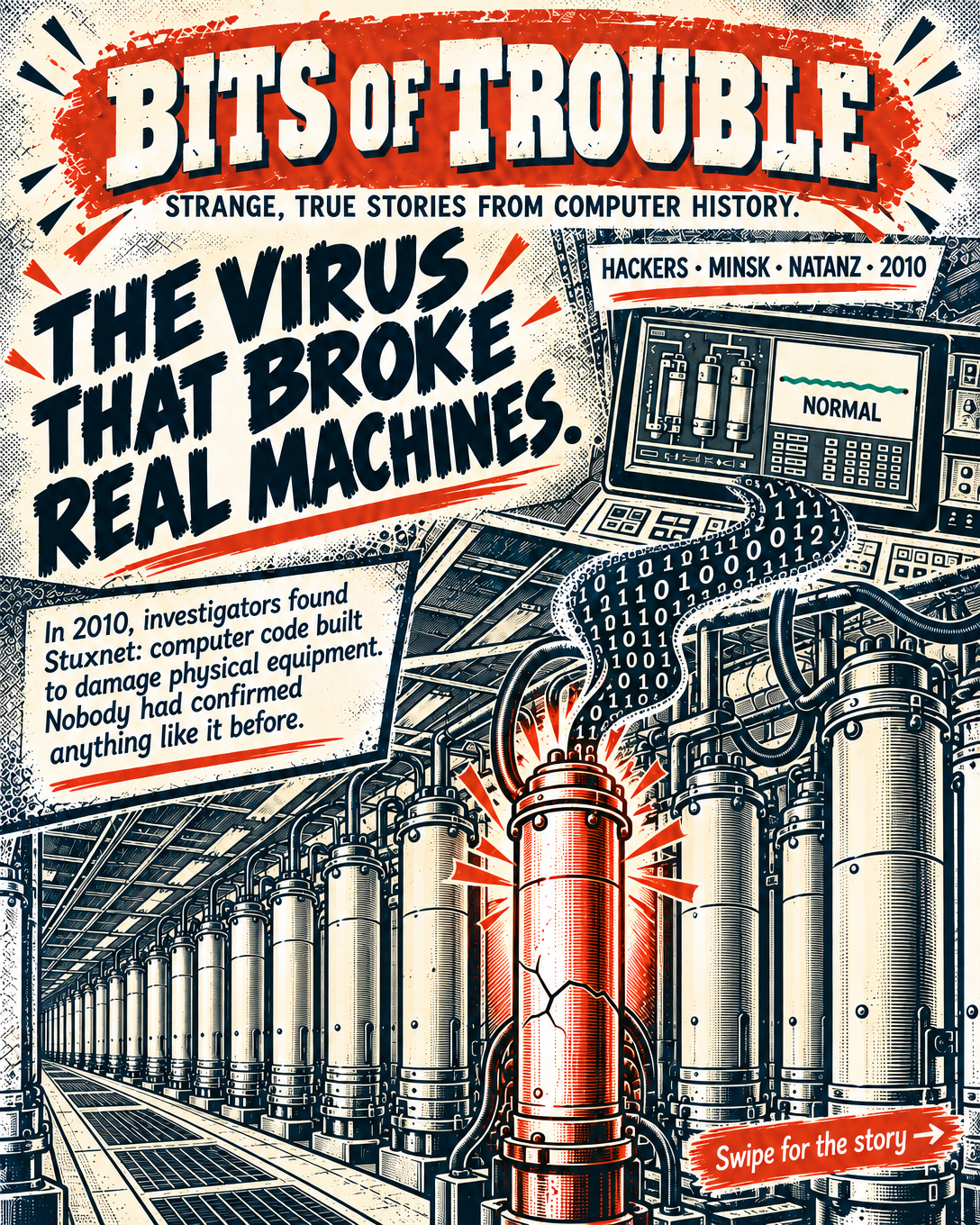
The story in 10 pages
The virus that broke real machines.
Read the comic as text
THE VIRUS THAT BROKE REAL MACHINES.
In 2010, investigators found Stuxnet: computer code built to damage physical equipment. Nobody had confirmed anything like it before.
THE COMPUTERS KEPT REBOOTING.
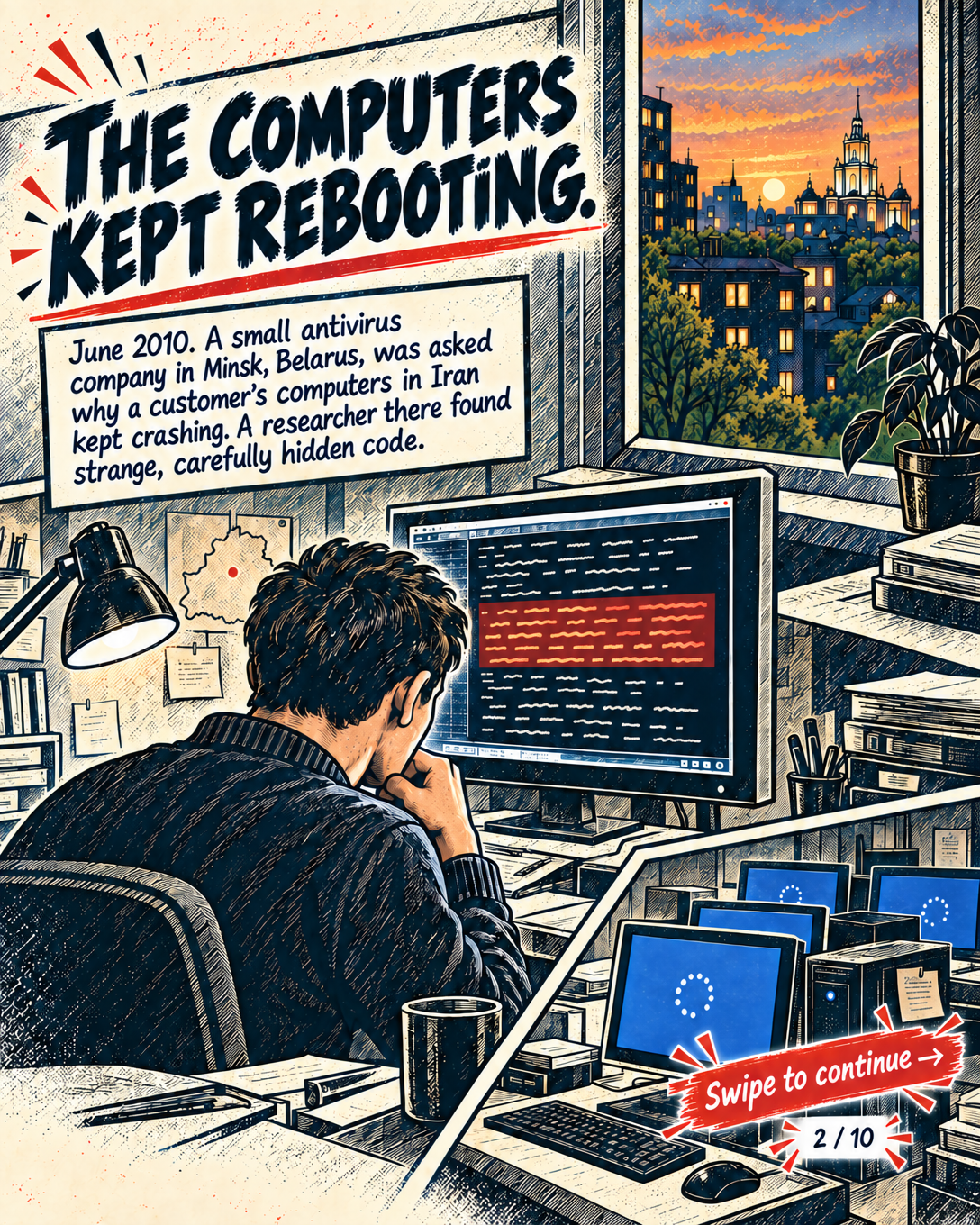
June 2010. A small antivirus company in Minsk, Belarus, was asked why a customer's computers in Iran kept crashing. A researcher there found strange, carefully hidden code.
HUGE. HIDDEN. AND DOING NOTHING?
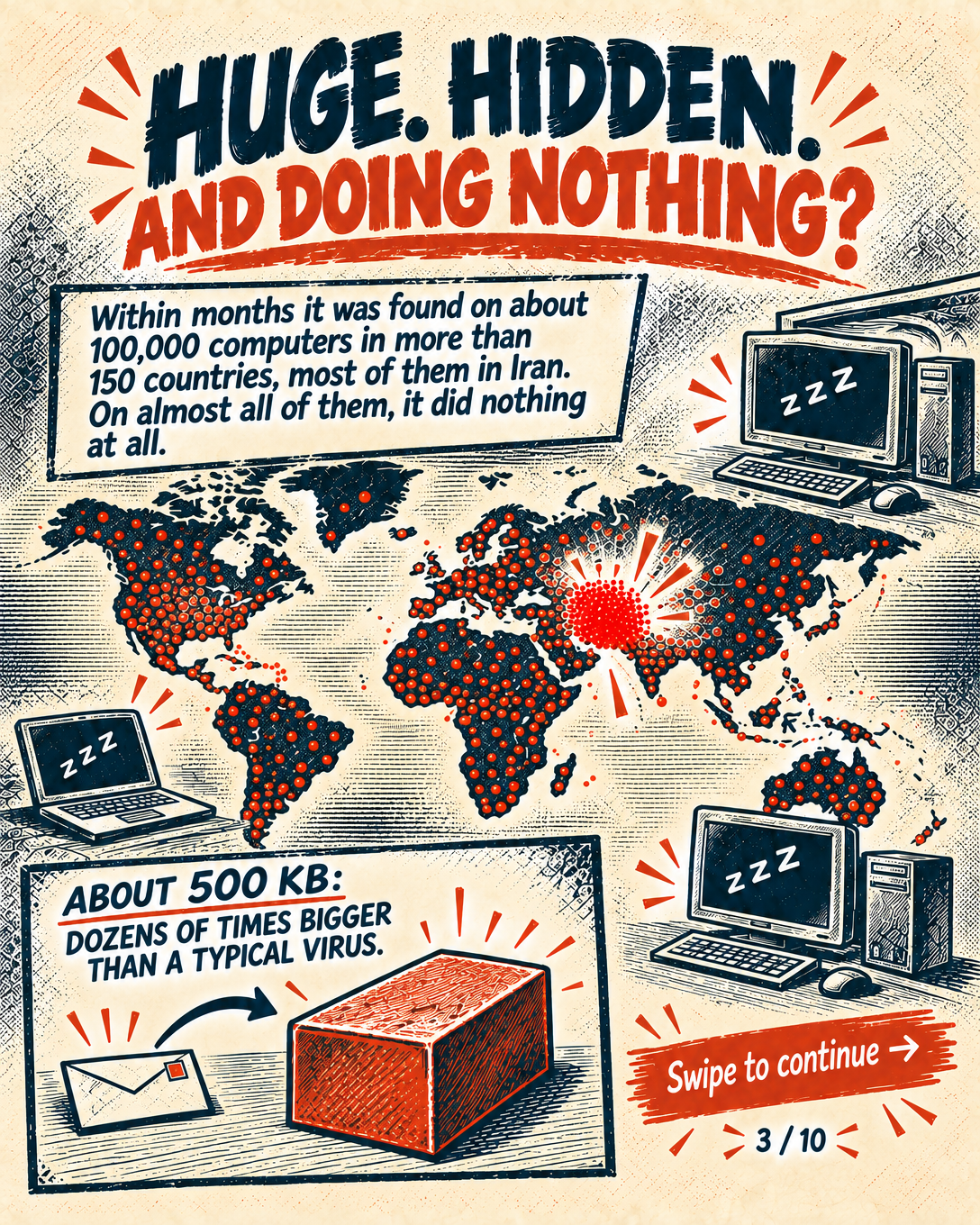
Within months it was found on about 100,000 computers in more than 150 countries, most of them in Iran. On almost all of them, it did nothing at all.
ABOUT 500 KB: DOZENS OF TIMES BIGGER THAN A TYPICAL VIRUS.
THE COMPUTERS THAT RUN MACHINES.
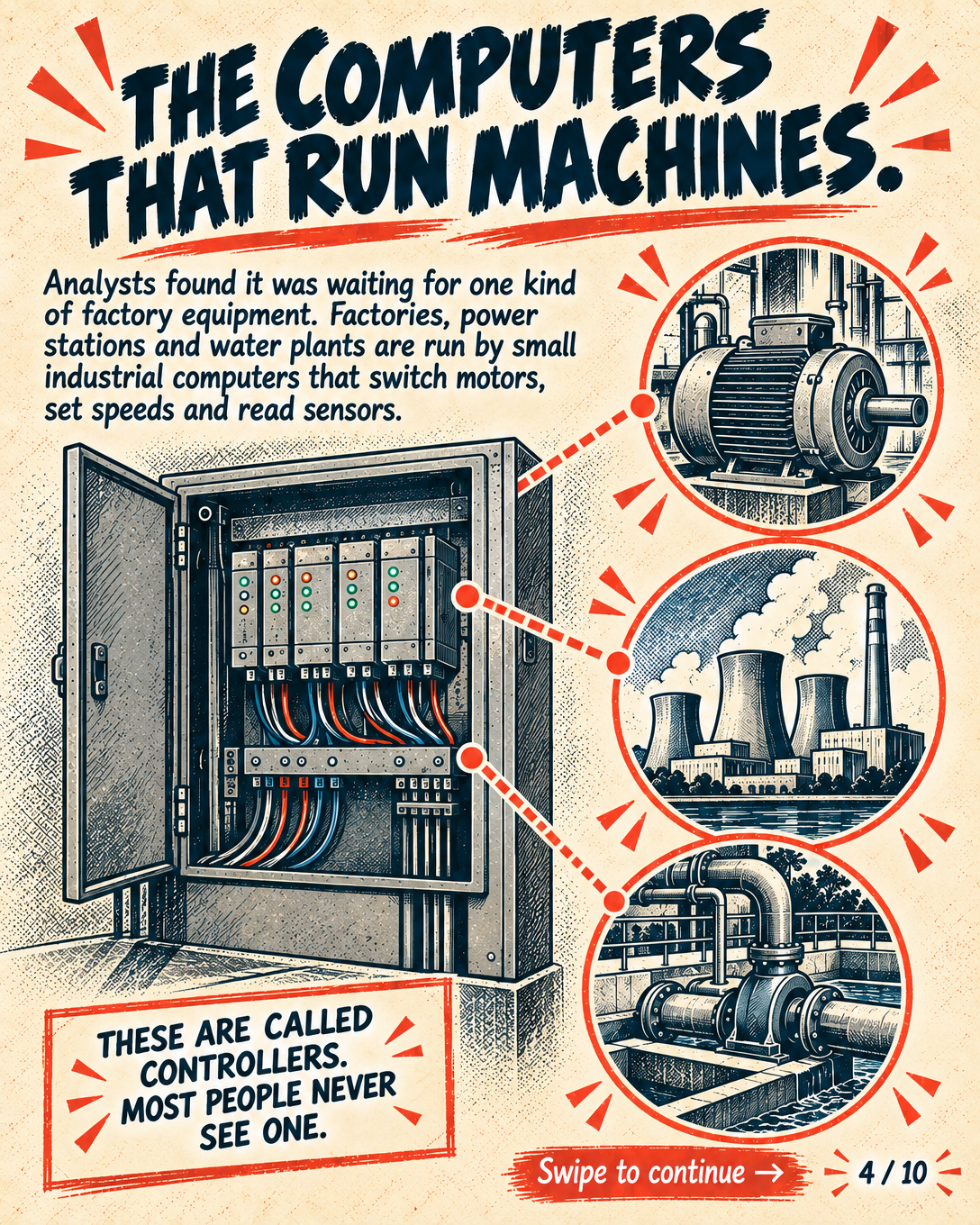
Analysts found it was waiting for one kind of factory equipment. Factories, power stations and water plants are run by small industrial computers that switch motors, set speeds and read sensors.
THESE ARE CALLED CONTROLLERS. MOST PEOPLE NEVER SEE ONE.
SPINNING ABOUT AS FAST AS SOUND.
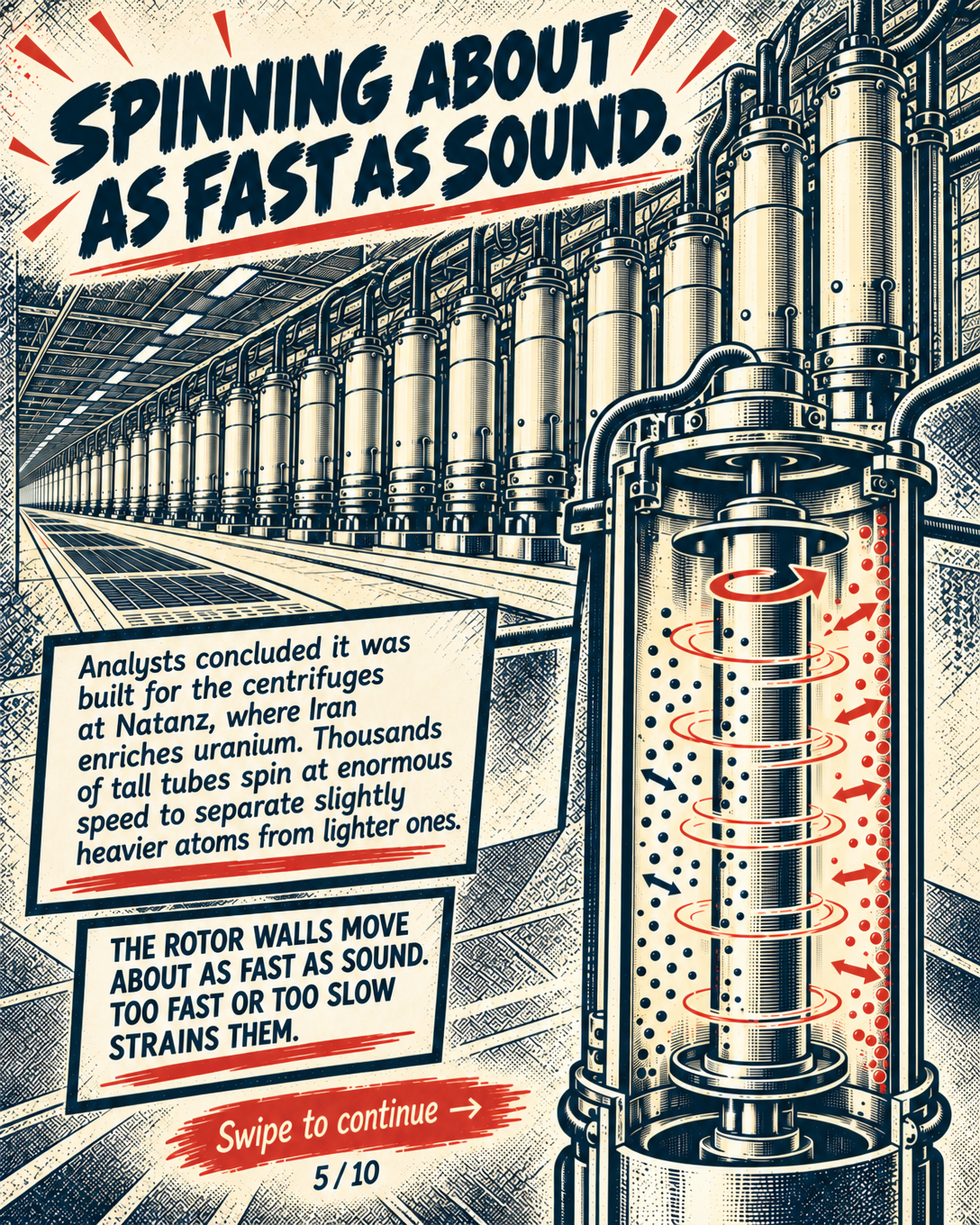
Analysts concluded it was built for the centrifuges at Natanz, where Iran enriches uranium. Thousands of tall tubes spin at enormous speed to separate slightly heavier atoms from lighter ones.
THE ROTOR WALLS MOVE ABOUT AS FAST AS SOUND. TOO FAST OR TOO SLOW STRAINS THEM.
THE SCREENS SAID ALL WAS WELL.
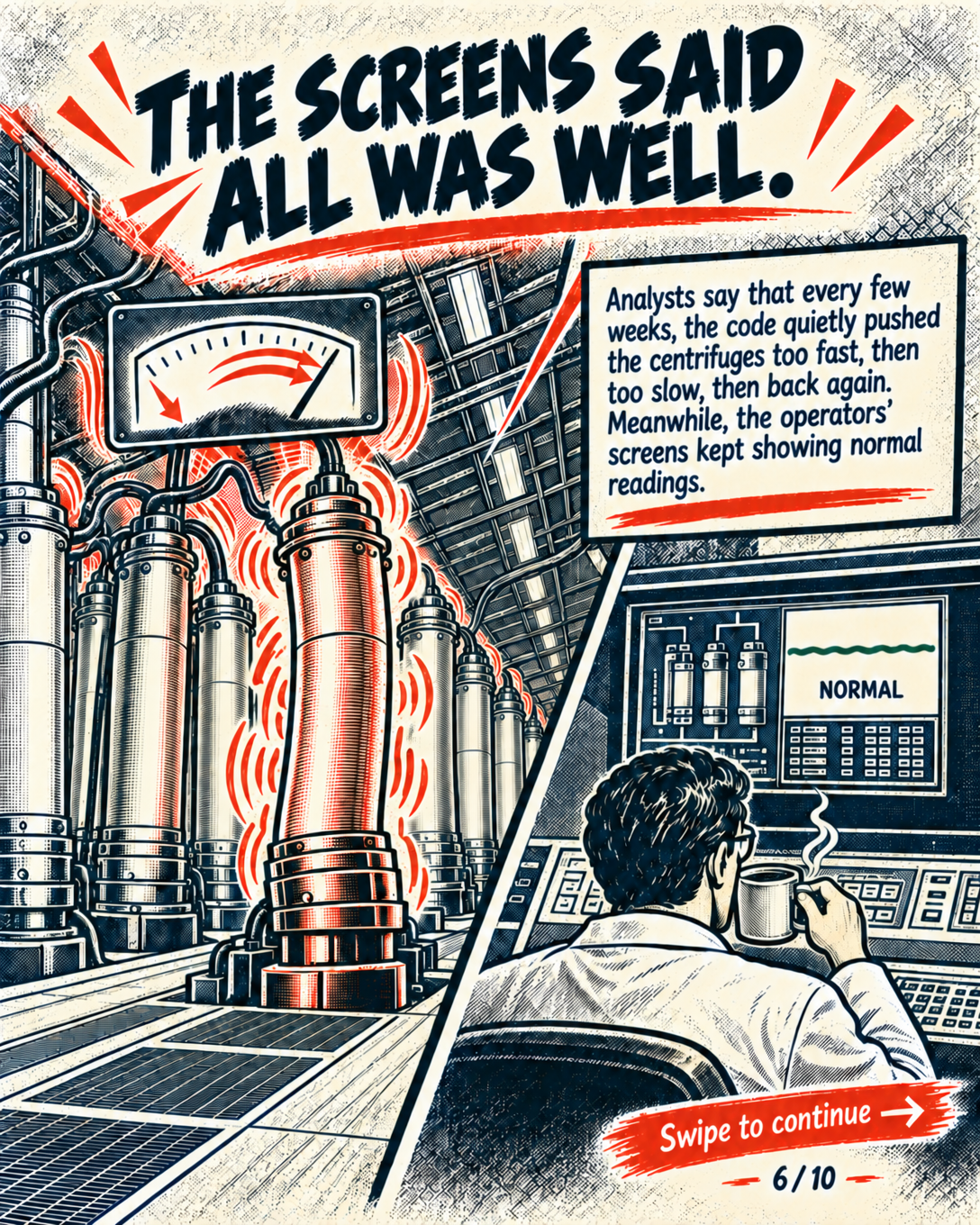
Analysts say that every few weeks, the code quietly pushed the centrifuges too fast, then too slow, then back again. Meanwhile, the operators' screens kept showing normal readings.
SLOW DAMAGE, NOT EXPLOSIONS.
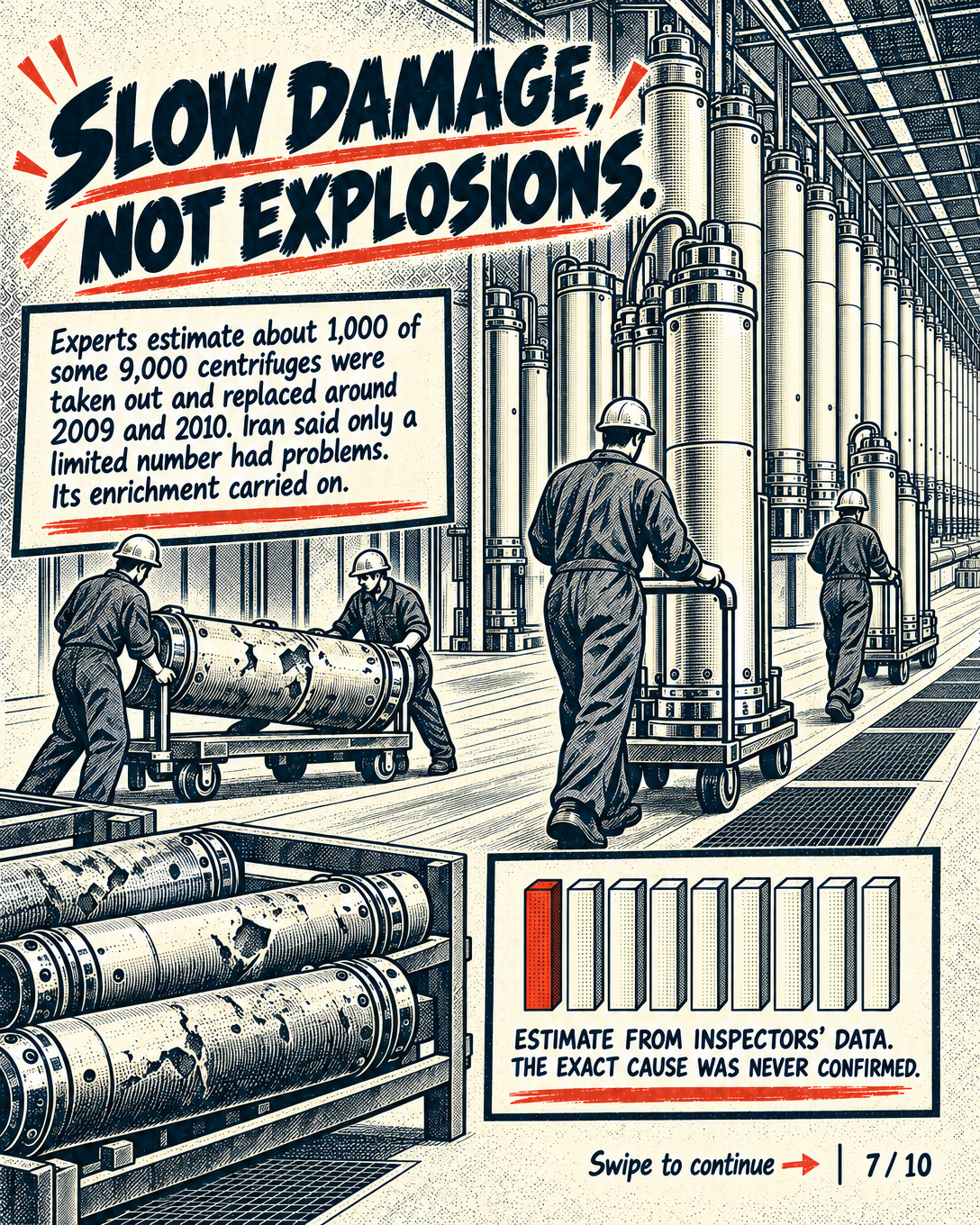
Experts estimate about 1,000 of some 9,000 centrifuges were taken out and replaced around 2009 and 2010. Iran said only a limited number had problems. Its enrichment carried on.
ESTIMATE FROM INSPECTORS' DATA. THE EXACT CAUSE WAS NEVER CONFIRMED.
WHO WROTE IT?
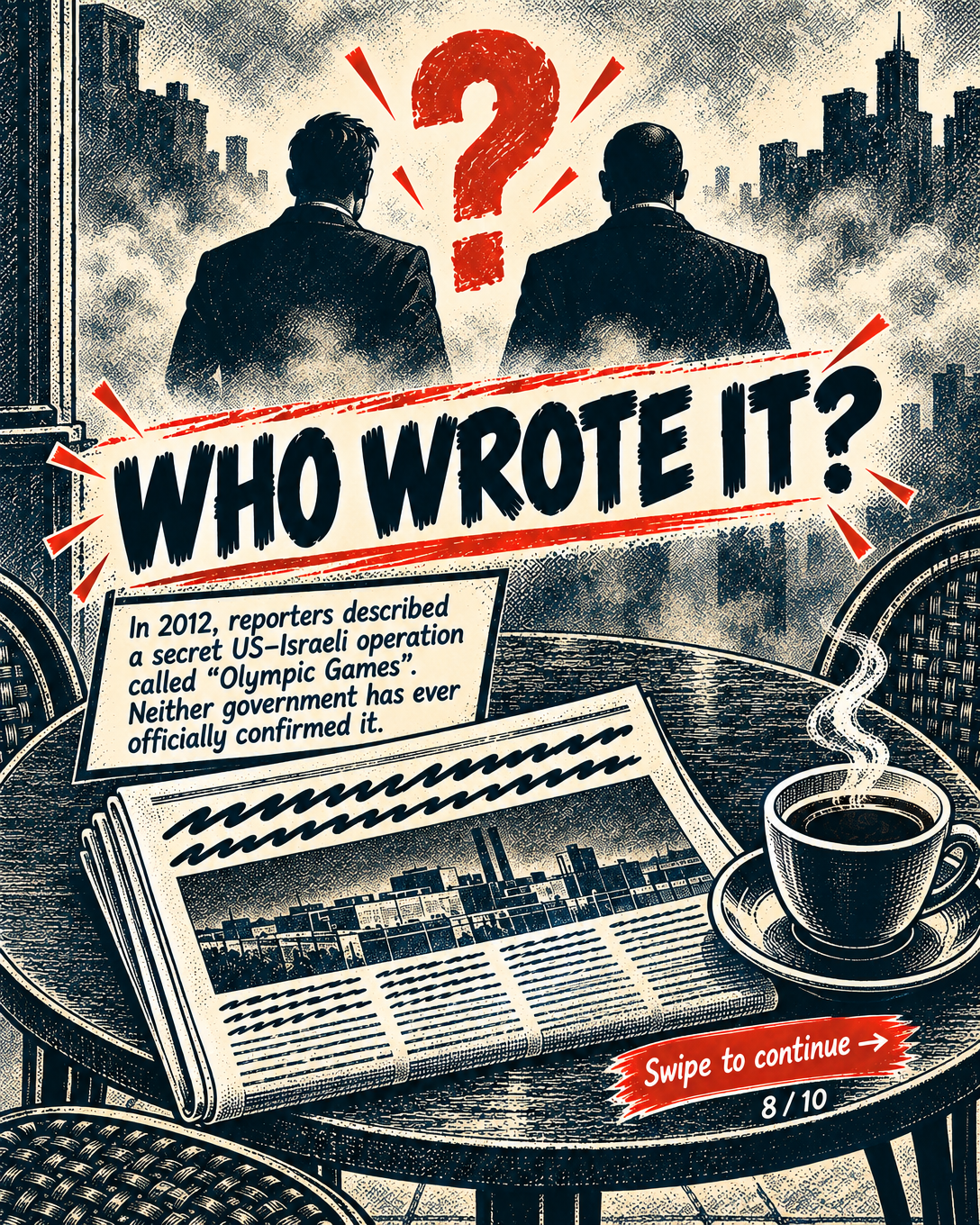
In 2012, reporters described a secret US–Israeli operation called "Olympic Games". Neither government has ever officially confirmed it.
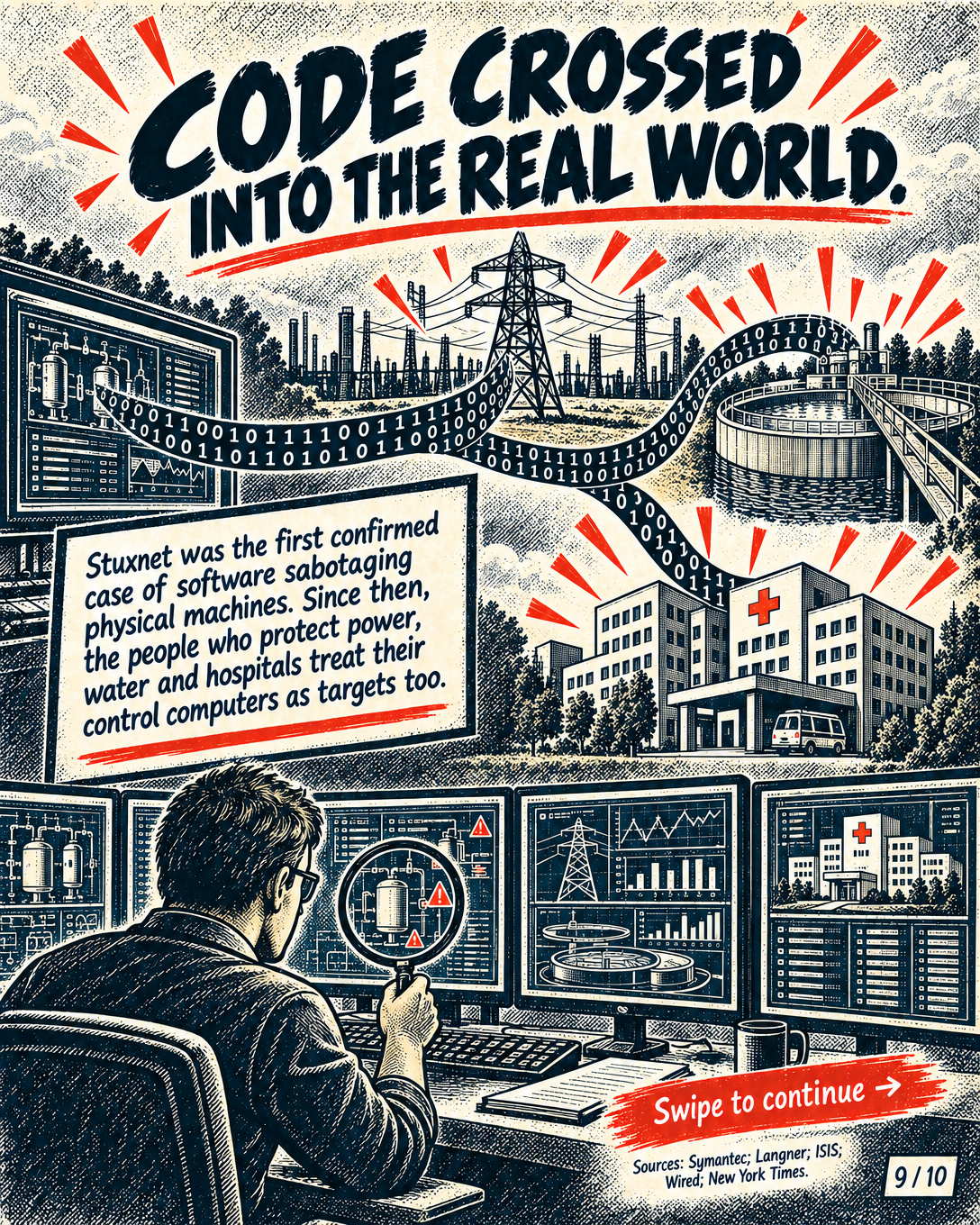
CODE CROSSED INTO THE REAL WORLD.
Stuxnet was the first confirmed case of software sabotaging physical machines. Since then, the people who protect power, water and hospitals treat their control computers as targets too.
WHAT REALLY HAPPENED?
How it was found. What we know and what is still disputed. The myths, corrected.
Behind the pictures
What we know,
and what is disputed.
A crash report from Iran
In June 2010, VirusBlokAda, a small antivirus company in Minsk, was asked to help a customer in Iran whose computers kept crashing and restarting. Sergey Ulasen and a colleague found code that hid itself with unusual care. On 12 July 2010 they warned the security community. Microsoft named it Stuxnet, from two file names inside it. Read Ulasen’s account.
Why was it so strange?
Most malware is small and greedy: it steals passwords, sends spam or demands money. Stuxnet was roughly half a megabyte, dozens of times larger than typical malware, and it took nothing. By the end of September 2010 it had reached about 100,000 computers in more than 150 countries, about 60% of them in Iran, yet on almost every one it simply waited. That patience was the clue that it had one particular target.
The computers that run machines
Analysts at Symantec and the German control-systems expert Ralph Langner worked out that Stuxnet was waiting for a specific arrangement of industrial controllers. These small, rugged computers sit inside factories, power stations, pipelines and water plants. They do not run apps or browse the web; they switch motors on and off, set speeds and read sensors many times a second. Stuxnet was built to reach these machines from ordinary computers.
Why centrifuges?
The setup Stuxnet hunted for matched the uranium-enrichment plant at Natanz. There, thousands of tall centrifuges spin uranium gas so fast that slightly heavier atoms drift outward and can be separated from lighter ones. The outer wall of each rotor moves at roughly the speed of sound. Machines like that are finely balanced: run them too fast and they are overstressed; slow them down and speed them up again and they shake as they pass through vibration points. Either way, parts wear and fail.
The screens said all was well
According to the published analyses, every few weeks the code briefly pushed the centrifuges’ speeds out of their normal range and then returned them, while the operators’ screens kept showing ordinary values. The aim appears to have been slow, deniable wear that looked like bad luck or poor manufacturing, not a dramatic explosion. That is the most important lesson for anyone running machines: a reassuring dashboard is not proof that the machines are fine.
What did it actually do?
The Institute for Science and International Security, reading inspectors’ reports, estimated that about 1,000 of Natanz’s roughly 9,000 centrifuges were taken out and replaced around late 2009 and early 2010. The inspectors could not confirm the cause. Iran’s president said a virus had caused “problems for a limited number of our centrifuges”, and Iran’s output of enriched uranium actually rose during 2010. Estimates of how much Stuxnet delayed the programme range from months to about two years. Read the ISIS analysis.
Who made it?
In 2012 the New York Times, citing anonymous officials, reported that Stuxnet was part of a joint US–Israeli operation code-named “Olympic Games”, begun under President George W. Bush and accelerated under President Obama. Neither government has officially confirmed this. Code alone rarely proves authorship, and the security researchers who analysed Stuxnet were careful not to claim it did. Read the New York Times report.
Why it still matters
Before Stuxnet, damage to physical equipment by software was mostly hypothetical. Afterwards, power companies, water utilities, hospitals and manufacturers had to treat their control systems as security targets, separate them from office networks, watch them independently and plan for the day the screens might lie. Stuxnet also showed that a carefully aimed tool can spread far beyond its target: copies ended up worldwide, studied by researchers and, inevitably, by other attackers.
Myths, corrected
- “The centrifuges exploded.” No. The design favoured slow, repeated stress that looked like ordinary failures.
- “It escaped from Natanz on an engineer’s laptop.” Disputed. Infection records analysed by Symantec point instead to Iranian contractor companies.
- “It was the first cyberattack ever.” It was the first confirmed case of code sabotaging physical machinery. An often-told story about a 1982 Siberian pipeline has never been substantiated.
- “It stopped Iran’s programme.” No. Enrichment continued and output rose in 2010.
What we drew
The researchers, operators, workers and officials in the comic are unnamed illustrative figures, not portraits. The centrifuge hall, control screens and cabinet are generic reconstructions, and the “NORMAL” screen is a visual shorthand. We have deliberately left out technical details of how the attack worked. The images are AI-generated illustrations with editorial review.
Follow the evidence
Sources & further reading
- Symantec: W32.Stuxnet Dossier v1.4 (Falliere, O Murchu, Chien, 2011)
Timeline p4; infection counts p5-6; target identification and concealment, used here only at summary level
- Ralph Langner: To Kill a Centrifuge (2013)
Design was gradual damage, not destruction (pp10-15); escape-from-Natanz story disputed (p18); outcome uncertain (p4)
- ISIS: Did Stuxnet Take Out 1,000 Centrifuges at the Natanz Enrichment Plant? (Dec 2010) and Update (Feb 2011)
~1,000 IR-1s replaced of ~8,700-9,000; LEU output rose in 2010; Ahmadinejad 29 Nov 2010 quote
- Kim Zetter, How Digital Detectives Deciphered Stuxnet (Wired, 11 July 2011)
Discovery, naming from file names, size ~500 KB vs 10-15 KB typical, Siberian pipeline story never substantiated
- David Sanger, Obama Order Sped Up Wave of Cyberattacks Against Iran (NYT, 1 June 2012)
Olympic Games; US-Israeli attribution from anonymous officials
- Kaspersky interview with Sergey Ulasen (2 Nov 2011)
Iranian customer's random crashes and reboots