
Networks · KwaZulu-Natal · 2009
The pigeon that
beat the broadband.
A slow internet line, a memory card and a racing pigeon: the funniest lesson in networking.
REAL HISTORY. REAL PHYSICS.
The story in 9 pages
The pigeon that beat the broadband.





Read the comic as text
THE PIGEON THAT BEAT THE BROADBAND.
A company was so fed up with its slow internet that it raced it against a bird carrying a memory card.
THE LINE WAS CRAWLING.
Unlimited IT's office in Howick, South Africa, kept sending files to another office near Durban. The connection was painfully slow. Someone joked that a pigeon would be faster.
MEET WINSTON.
In September 2009 they tried it. Winston, an 11-month-old racing pigeon, carried a 4 GB memory card strapped to his leg. The internet upload got a head start.
4 GB = 32 BILLION BITS. EVERY 1 AND 0 COUNTS.
A RACE FOLLOWED LIVE.
Winston flew home across the hills, about 70 km. People followed the race on Twitter, some complaining their own connections were too slow to watch.
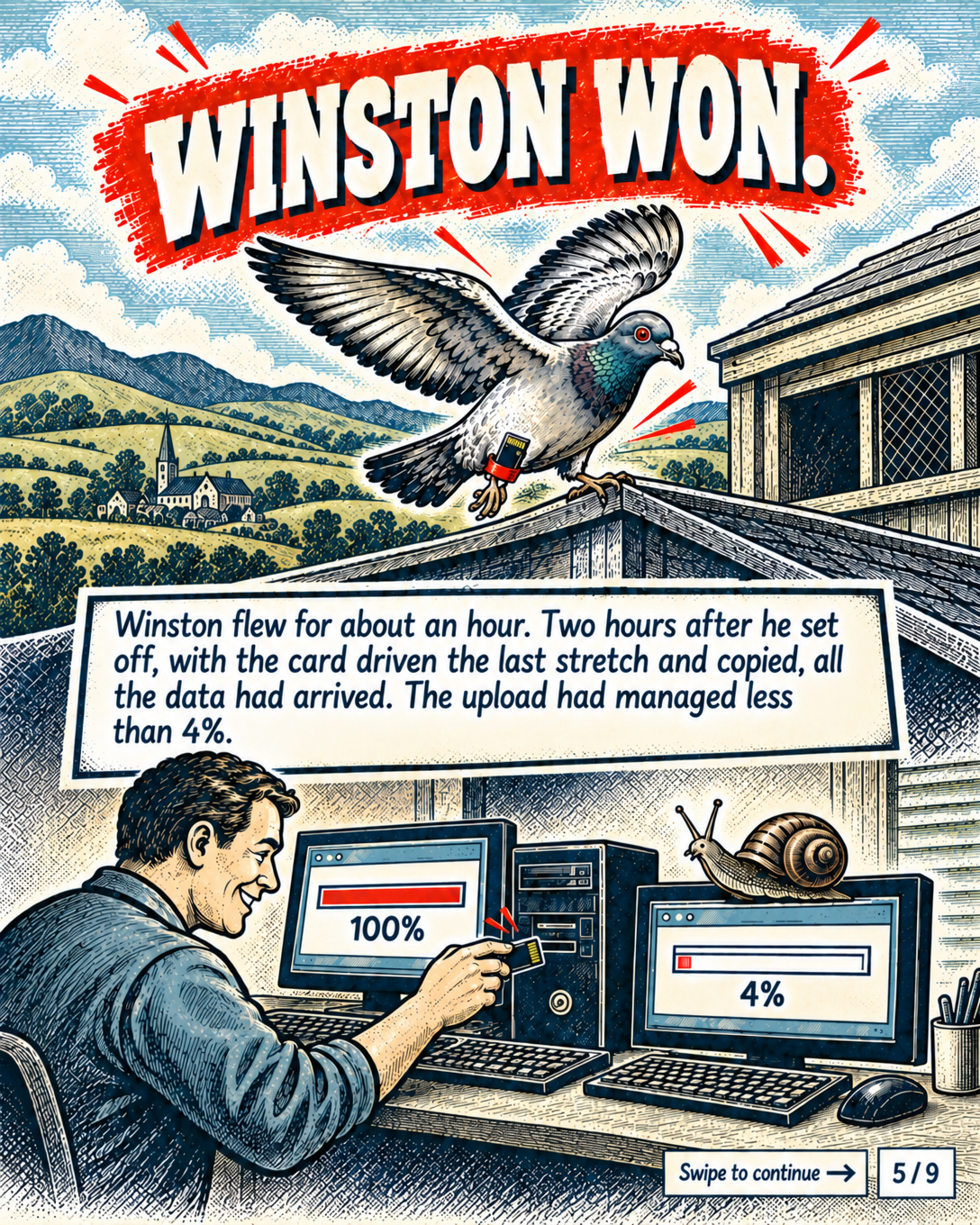
WINSTON WON.
Winston flew for about an hour. Two hours after he set off, with the card driven the last stretch and copied, all the data had arrived. The upload had managed less than 4%.
BANDWIDTH: HOW MUCH ARRIVES.
Winston carried all 32 billion bits at once. Spread over two hours, that is about 4 million bits every second, roughly 30 times faster than that line.
BANDWIDTH = HOW MUCH DATA ARRIVES EACH SECOND.
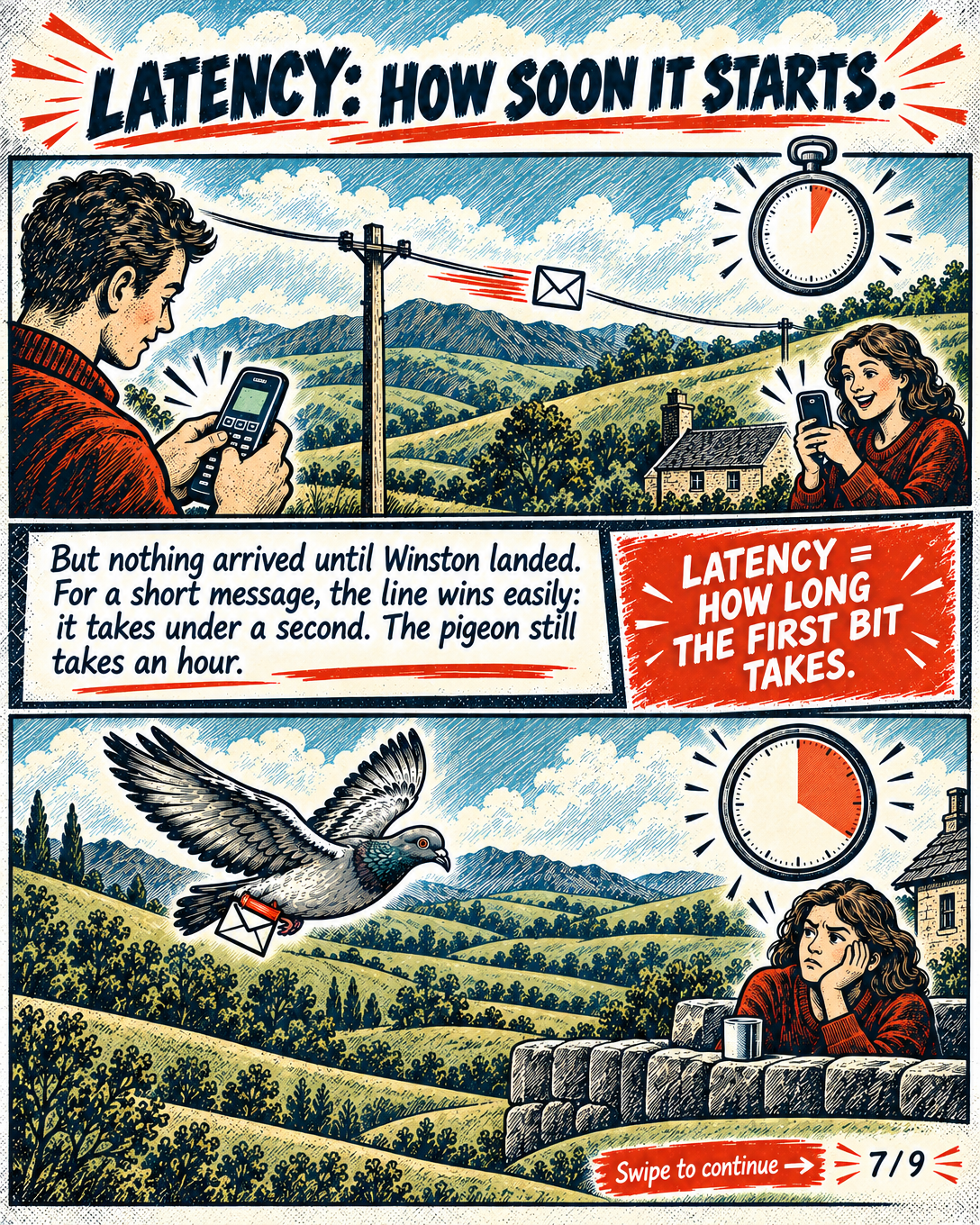
LATENCY: HOW SOON IT STARTS.
But nothing arrived until Winston landed. For a short message, the line wins easily: it takes under a second. The pigeon still takes an hour.
LATENCY = HOW LONG THE FIRST BIT TAKES.
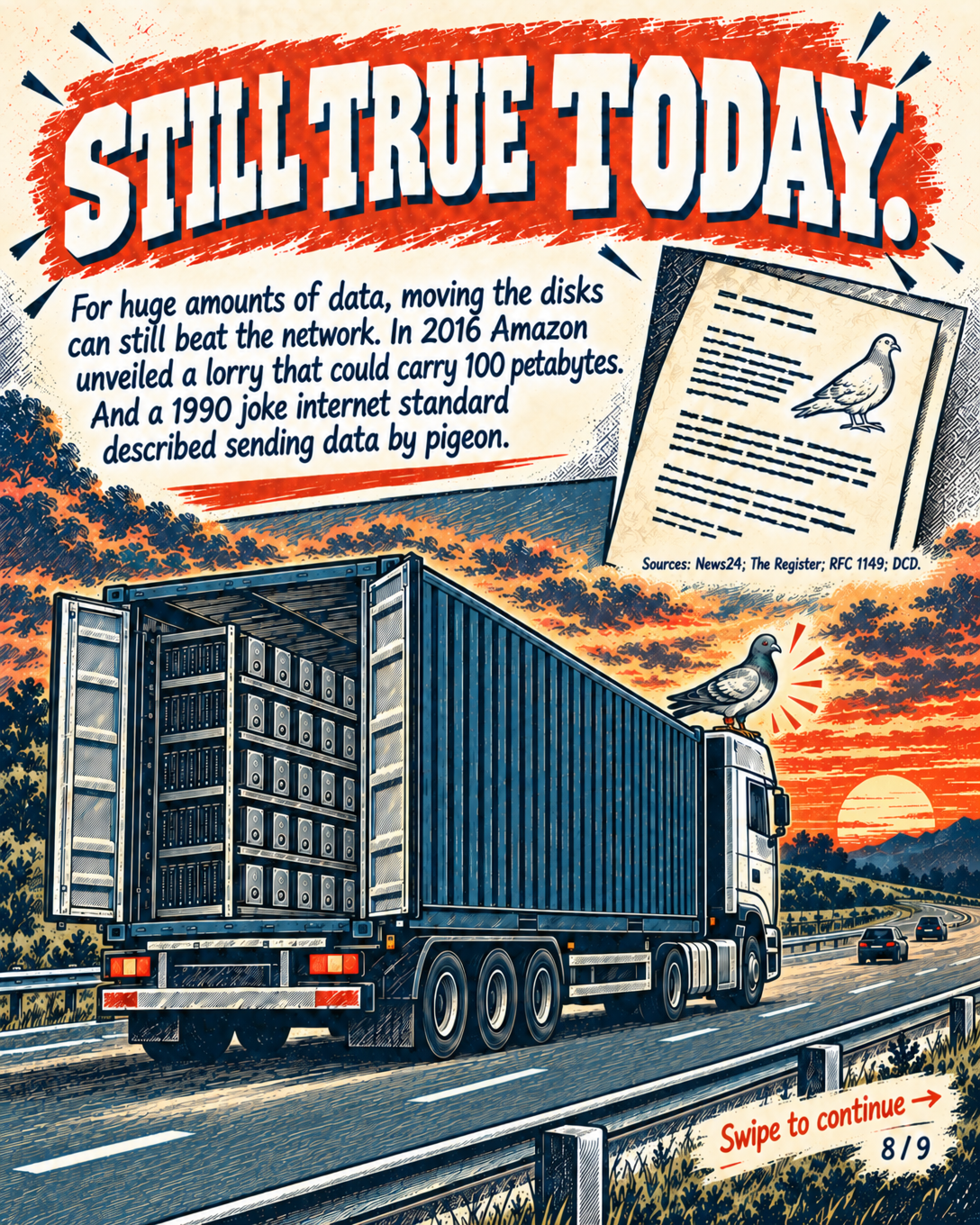
STILL TRUE TODAY.
For huge amounts of data, moving the disks can still beat the network. In 2016 Amazon unveiled a lorry that could carry 100 petabytes. And a 1990 joke internet standard described sending data by pigeon.
RACE A PIGEON.
Who won, by how much, and why it was a stunt. Try our pigeon-versus-internet calculator.
Behind the pictures
Bandwidth versus
latency, explained.
A slow line and a running joke
In September 2009, staff at Unlimited IT in Howick, KwaZulu-Natal, were fed up. Sending large files to a sister office near Durban, about 70 km away, took hours over their ADSL line. The joke that a pigeon would be faster turned into a publicity stunt, followed live on Twitter. Read News24’s report from the day.
The race
Winston, an 11-month-old racing pigeon, set off with a 4 GB memory card strapped to his leg. The upload was given a head start. Winston flew for about an hour, then the card was driven the last stretch and copied. About two hours after he left, all the data had arrived. The upload had managed less than 4%. Telkom, the phone company, said the customer had not taken up its recommendations. Read The Register’s account.
Bandwidth: how much arrives
A 4 GB card holds about 32 billion bits. Delivering all of them in roughly two hours works out at about 4 million bits every second, around 30 times what that line achieved. That number is what engineers call bandwidth or throughput: how much data gets through per second, on average.
Latency: how soon it starts
Bandwidth is not the whole story. With the pigeon, nothing arrives until it lands. That wait before the first bit shows up is latency. For a short message, the slow line still wins easily: it arrives in a fraction of a second, while Winston takes an hour whatever he carries. Video calls and games care most about latency; backups and big uploads care most about bandwidth.
Still true today
For truly enormous amounts of data, physically moving the disks can still beat the network. In 2016 Amazon Web Services unveiled Snowmobile, a 45-foot shipping container on a lorry that could carry 100 petabytes; it was withdrawn in 2024. Read about Snowmobile. Engineers had seen the joke coming: on 1 April 1990, an April Fools specification described sending internet data by pigeon, with “high delay, low throughput”. Read RFC 1149.
What it did and did not prove
- It was a stunt. It measured one company’s line on one day, not South African internet in general.
- Reports differ. Distances are given as about 70 km or 60 miles, and timings vary with what is counted (flight only, or flight plus driving and copying). We use the conservative figures.
- The point still stands. Carrying data can give huge bandwidth with terrible latency.
What we drew
The office workers are unnamed illustrative figures. Winston is drawn as a generic racing pigeon, not from a photograph. The images are AI-generated illustrations with editorial review.
Try it
Pigeon versus internet
Follow the evidence
Sources & further reading
- News24: Pigeon beats Telkom (9 September 2009)
Winston; 4GB card; Howick to Hillcrest (~70 km); ADSL given a 26-minute head start; just under 4% complete; 2h06m57s door to door
- The Register: SA pigeon outpaces broadband (10 September 2009)
Unlimited IT; Winston, 11 months; 1h08 flight; ~4% transferred; Telkom response
- RFC 1149: A Standard for the Transmission of IP Datagrams on Avian Carriers (D. Waitzman, 1 April 1990)
April Fools specification for internet data by pigeon: 'high delay, low throughput'
- DCD: AWS Snowmobile delivers petabytes to the cloud by truck (2016) and AWS retires Snowmobile (2024)
45 ft, 100 PB shipping container on a lorry; announced 2016; withdrawn 2024