
Cambridge · 1991–1993 · A very human invention
They wanted coffee.
The world wanted a look.
A long walk. An empty pot. A tiny frustration that became an unexpectedly famous invention.
REAL HISTORY. STRANGE CONSEQUENCES.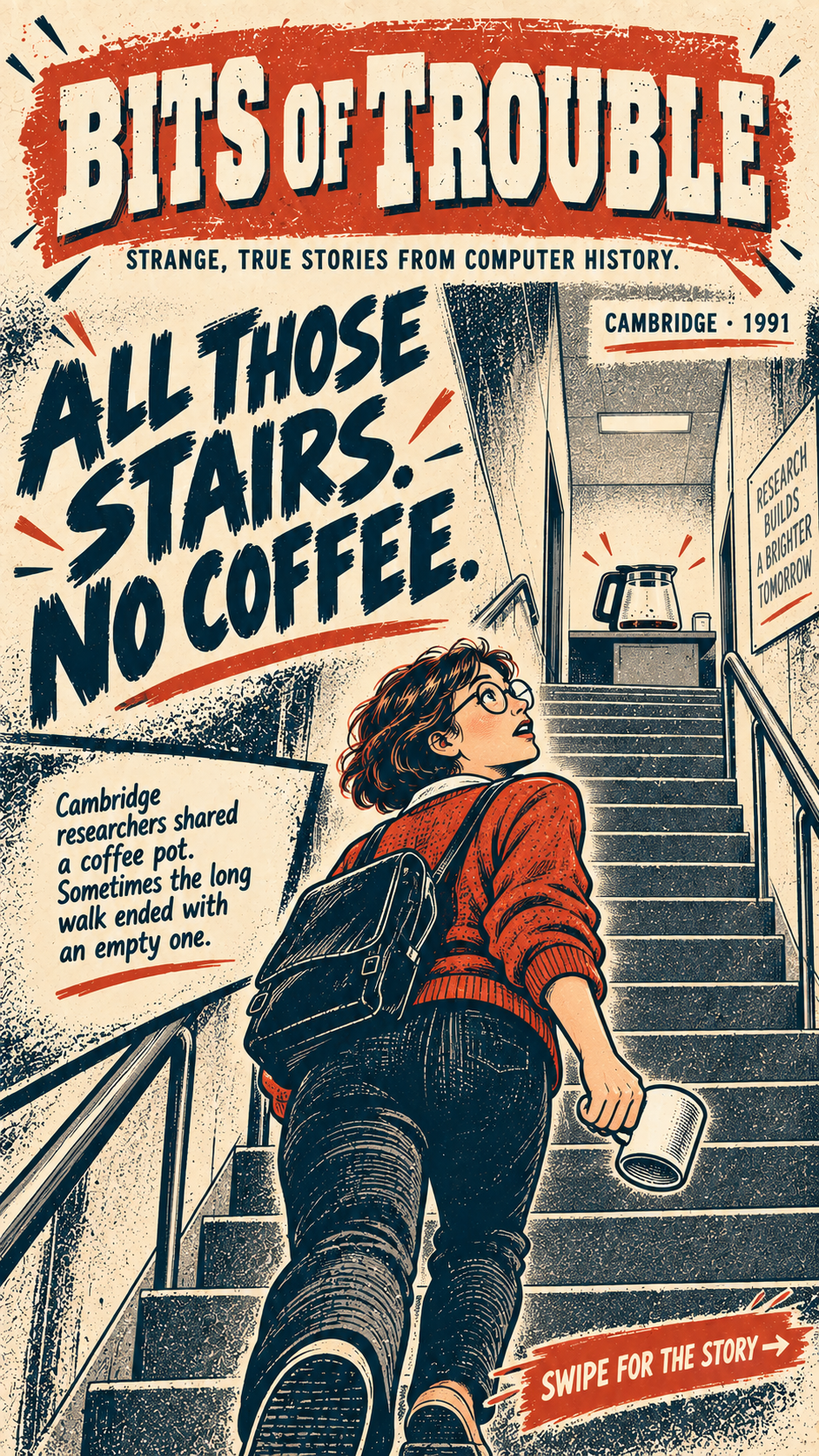
The story in three pages
All those stairs. No coffee.
Read the comic as text
ALL THOSE STAIRS. NO COFFEE.
Cambridge researchers shared a coffee pot. Sometimes the long walk ended with an empty one.
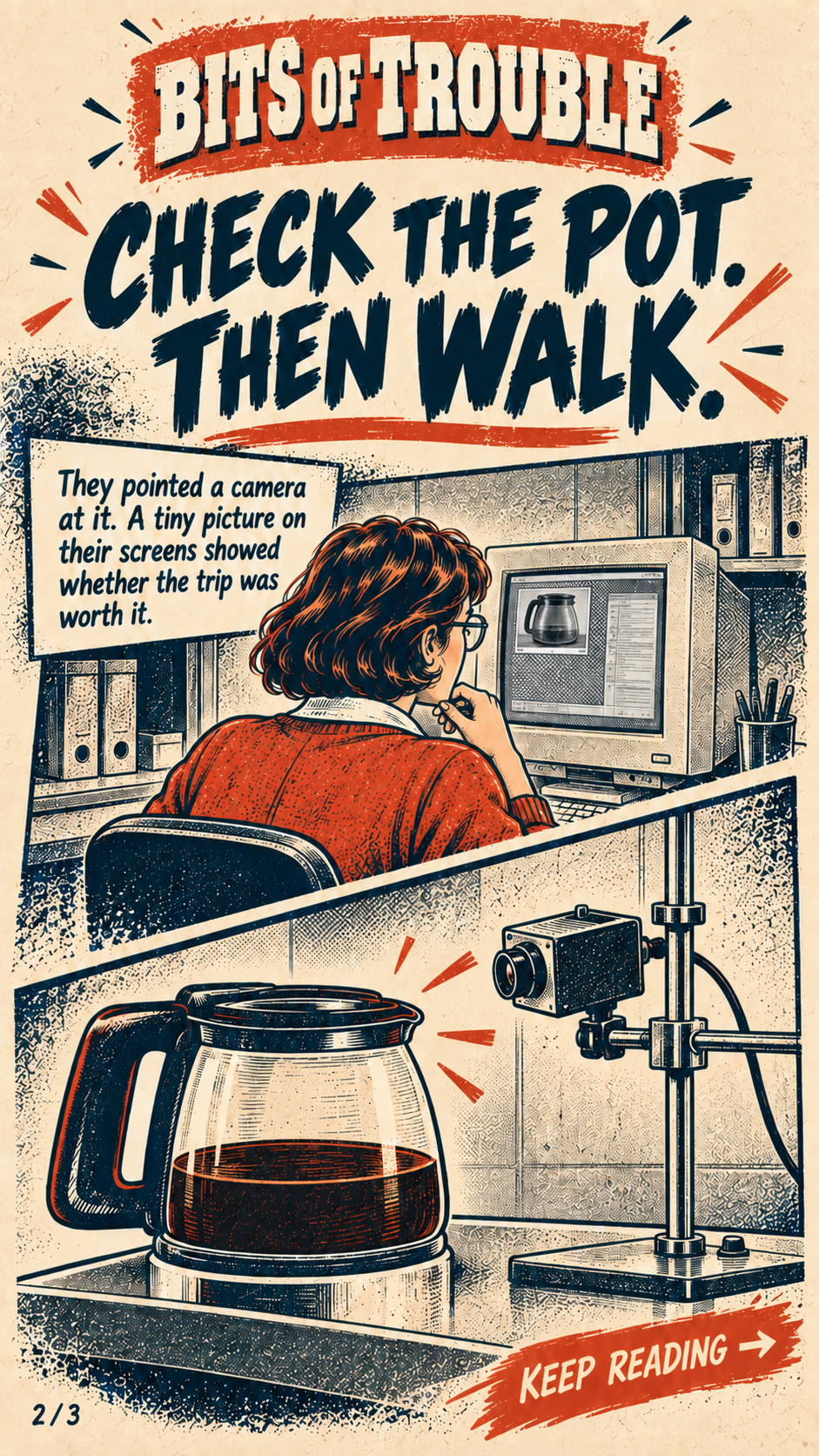
CHECK THE POT. THEN WALK.
They pointed a camera at it. A tiny picture on their screens showed whether the trip was worth it.
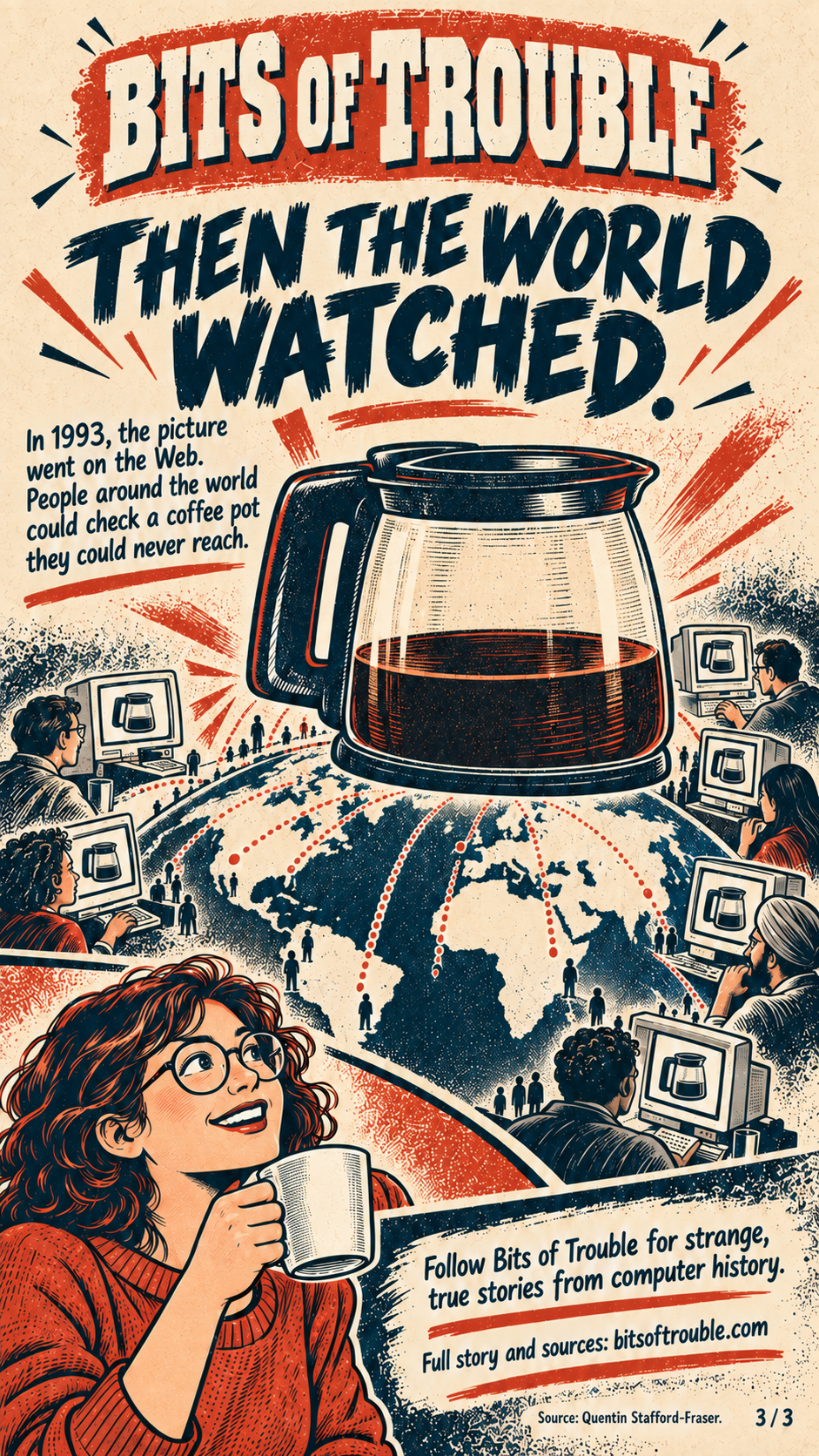
THEN THE WORLD WATCHED.
In 1993, the picture went on the Web. People around the world could check a coffee pot they could never reach.
Behind the pictures
A small problem.
A very large audience.
A small, familiar problem
Researchers in different parts of Cambridge’s Computer Laboratory used a shared coffee machine. Some climbed several flights of stairs only to discover that somebody else had finished the pot.
First the lab, then the Web
In 1991, a camera and spare frame-grabber fed pictures to the local network. Paul Jardetzky wrote the server and Quentin Stafford-Fraser the client. A small greyscale picture told colleagues whether to make the trip. In November 1993, Daniel Gordon and Martyn Johnson made the images available on the Web.
Why it still feels familiar
The delight is the mismatch between the tiny problem and the enormous audience it found. The comic’s researcher is an illustrative composite. Its jug is a continuity prop, not a verified manufacturer’s model; a later replacement machine should not be mistaken for the 1991 original.
A local camera system lets colleagues check the pot.
In November, the pictures become accessible on the Web.
The camera is finally switched off on 22 August.
What the drawings reconstruct
The researcher is an invented composite, not a portrait of an inventor. The stairs and room are illustrative. The jug follows our reference prop, but its manufacturer is not established here. These are AI-generated illustrations with editorial review; the historical account comes from the sources below.
Follow the evidence
Further reading, straight from the people involved.
- Quentin Stafford-Fraser: The Trojan Room Coffee Pot — a biography
A participant’s account of the shared pot, the stairs and the local camera system.
- The Coffee Pot Timeline
The separate 1991 and November 1993 milestones, and the camera’s 2001 switch-off.