
U.S. Navy · 1960s–1980s · Time you can hold
She carried nanoseconds
in her handbag.
Grace Hopper couldn’t picture a billionth of a second. So she had one cut to length.
REAL HISTORY. REAL PHYSICS.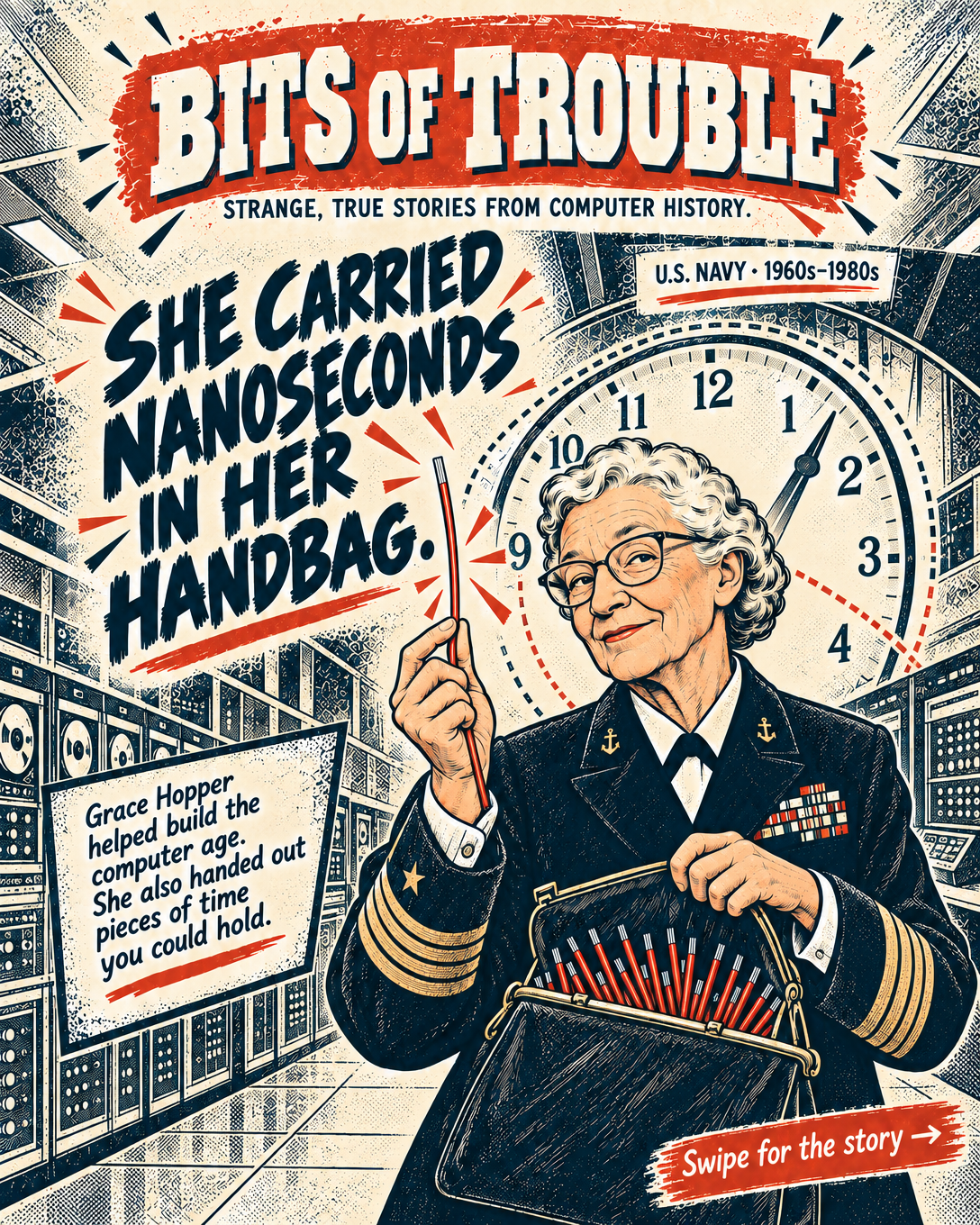
The story in 9 pages
She carried nanoseconds in her handbag.
Read the comic as text
SHE CARRIED NANOSECONDS IN HER HANDBAG.
Grace Hopper helped build the computer age. She also handed out pieces of time you could hold.
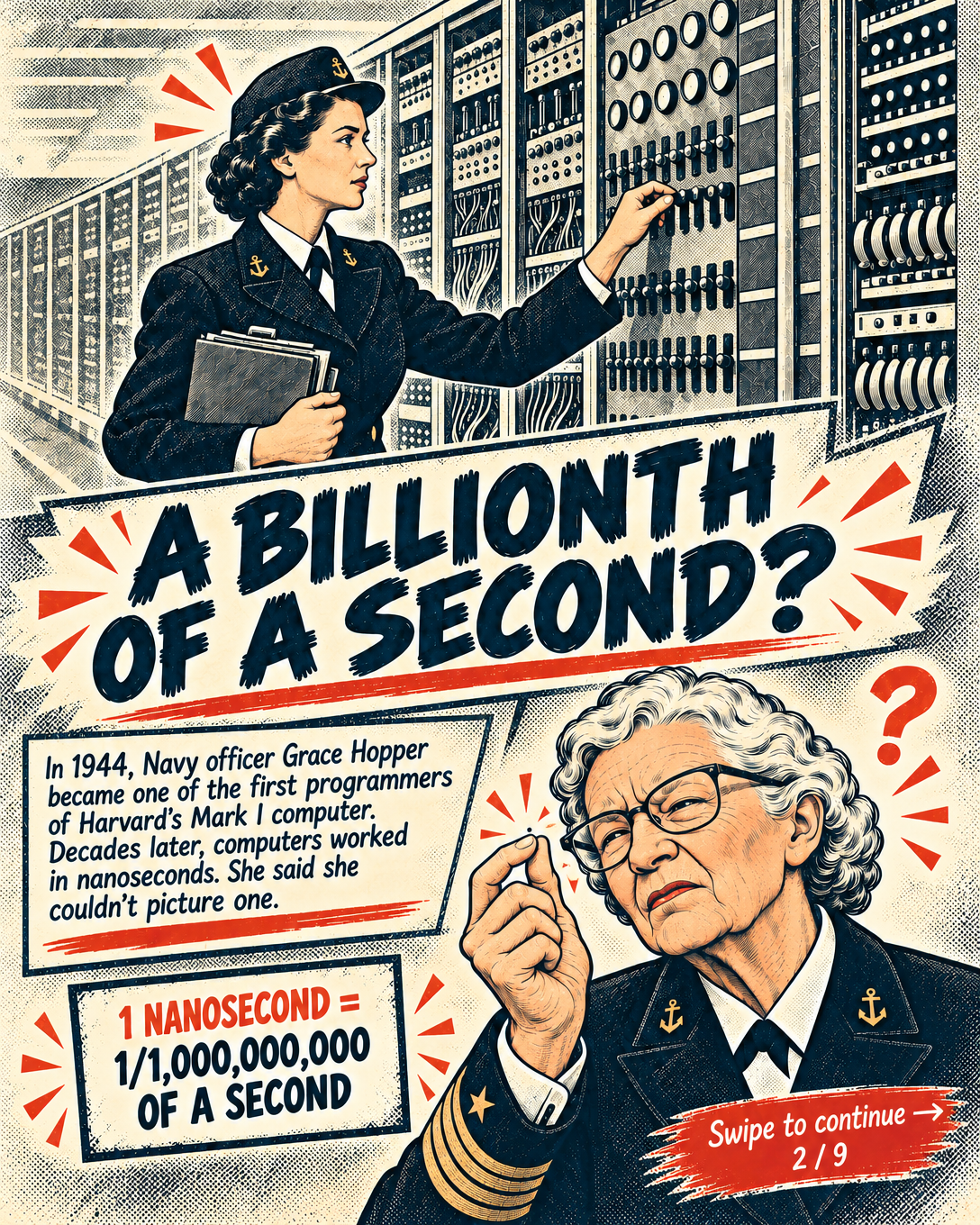
A BILLIONTH OF A SECOND?
In 1944, Navy officer Grace Hopper became one of the first programmers of Harvard's Mark I computer. Decades later, computers worked in nanoseconds. She said she couldn't picture one.
1 NANOSECOND = 1/1,000,000,000 OF A SECOND
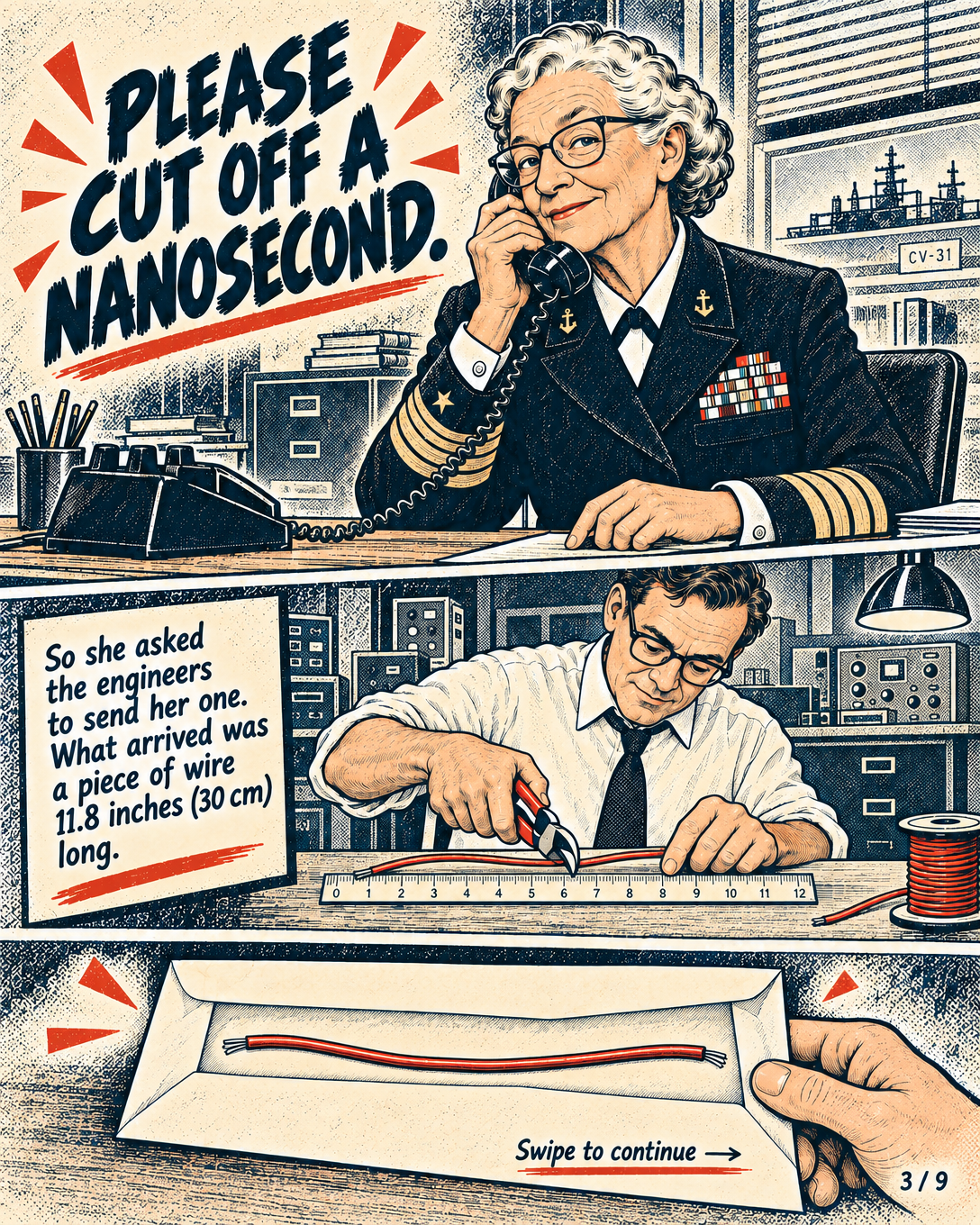
PLEASE CUT OFF A NANOSECOND.
So she asked the engineers to send her one. What arrived was a piece of wire 11.8 inches (30 cm) long.
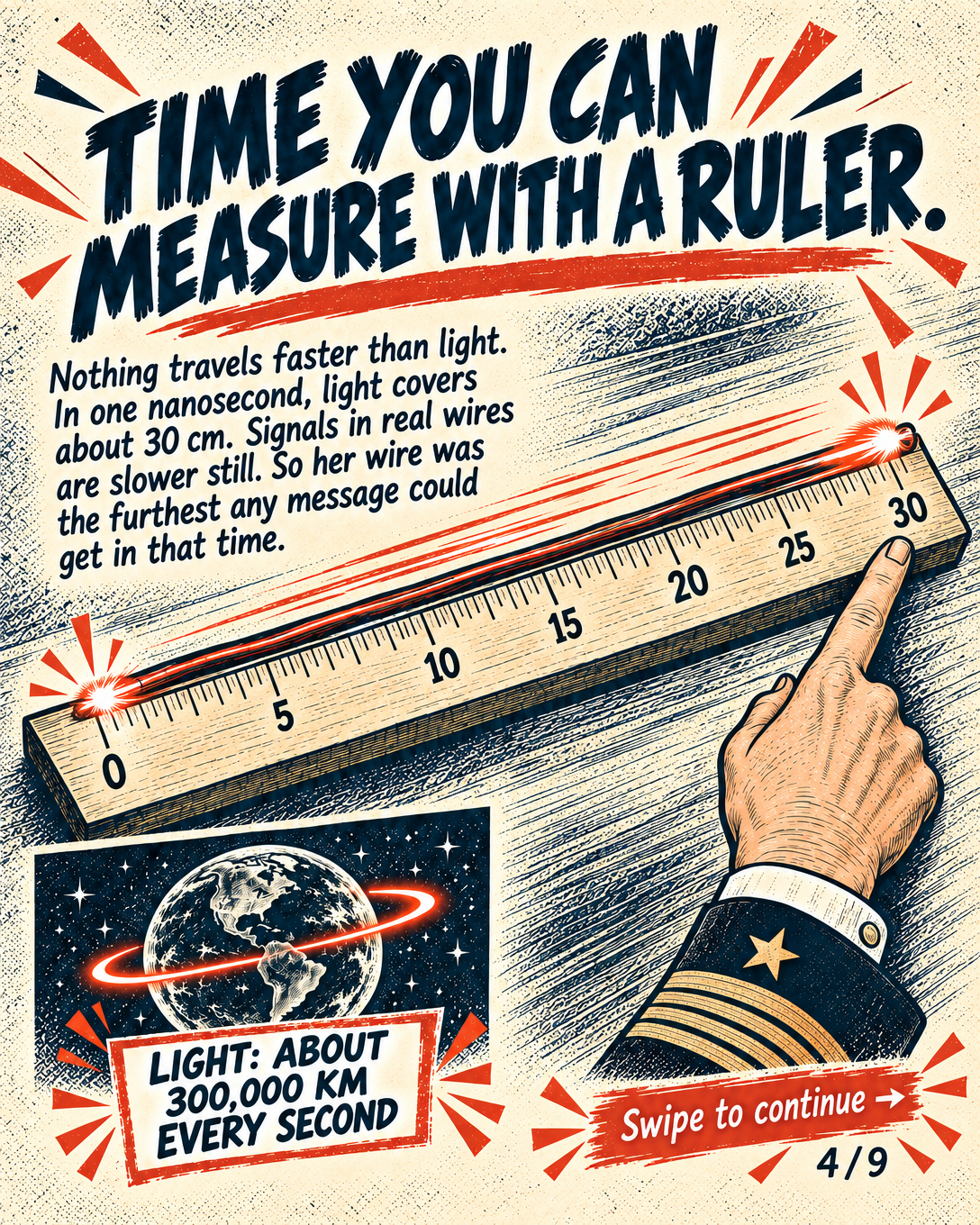
TIME YOU CAN MEASURE WITH A RULER.
Nothing travels faster than light. In one nanosecond, light covers about 30 cm. Signals in real wires are slower still. So her wire was the furthest any message could get in that time.
LIGHT: ABOUT 300,000 KM EVERY SECOND
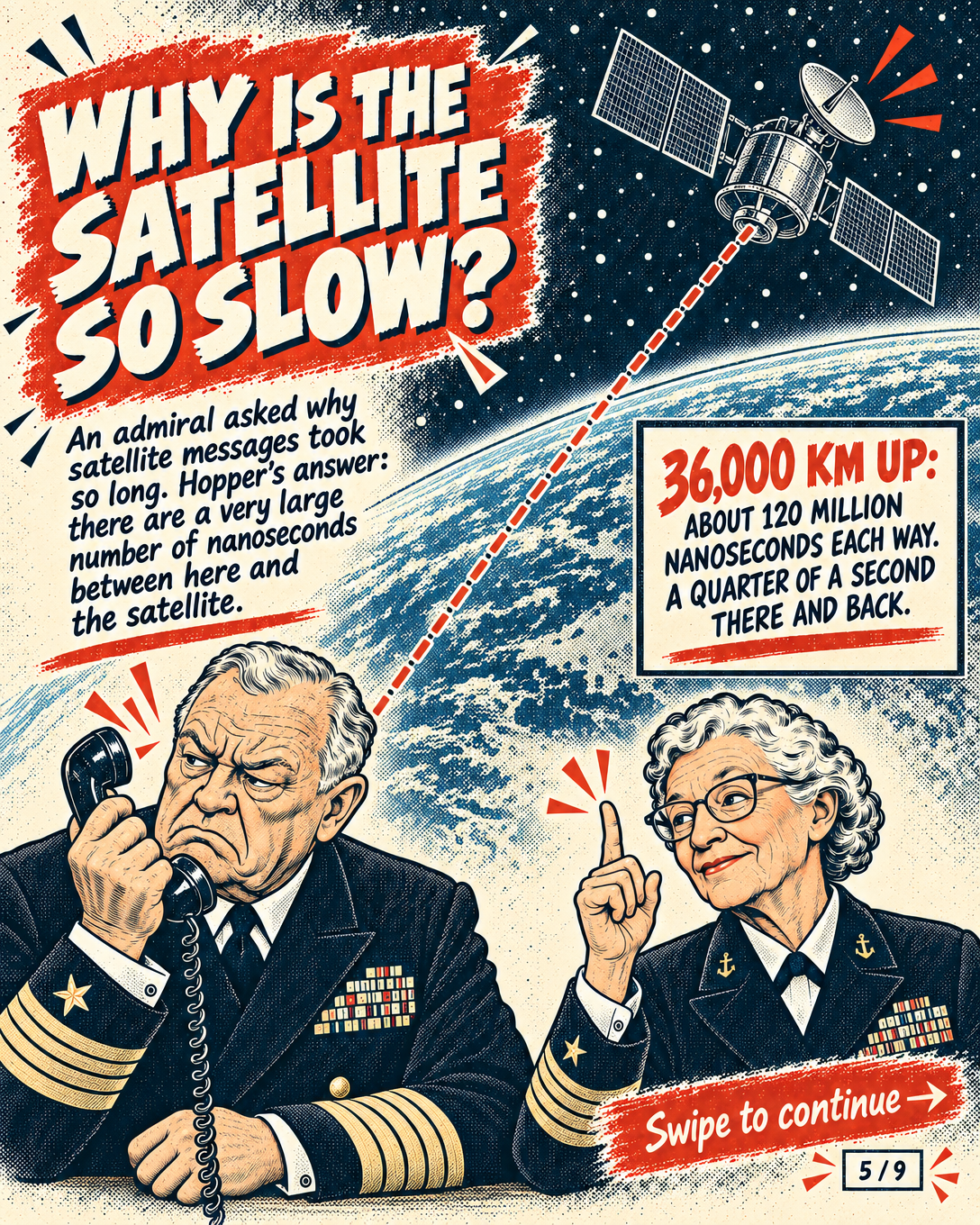
WHY IS THE SATELLITE SO SLOW?
An admiral asked why satellite messages took so long. Hopper's answer: there are a very large number of nanoseconds between here and the satellite.
36,000 KM UP: ABOUT 120 MILLION NANOSECONDS EACH WAY. A QUARTER OF A SECOND THERE AND BACK.
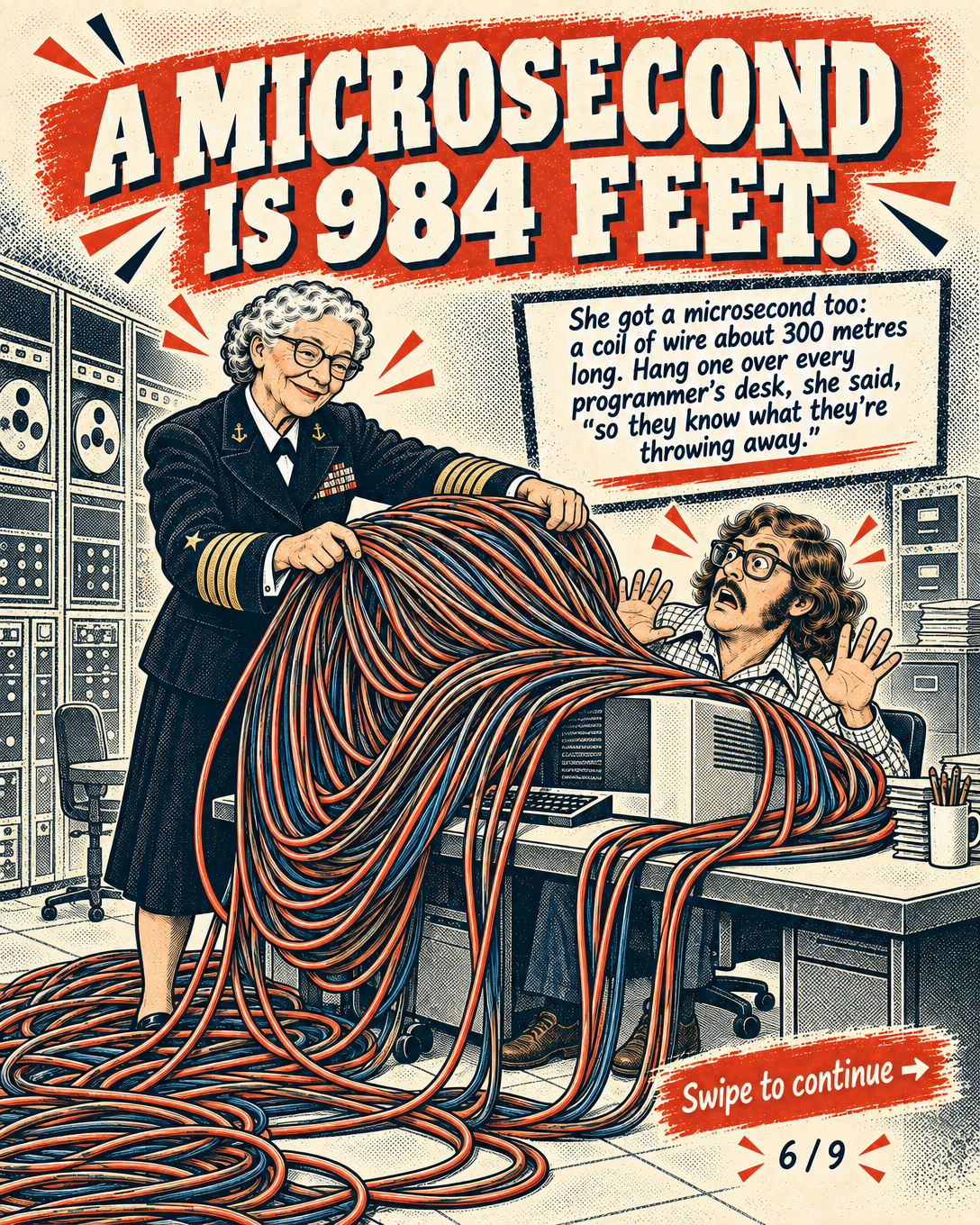
A MICROSECOND IS 984 FEET.
She got a microsecond too: a coil of wire about 300 metres long. Hang one over every programmer's desk, she said, "so they know what they're throwing away."
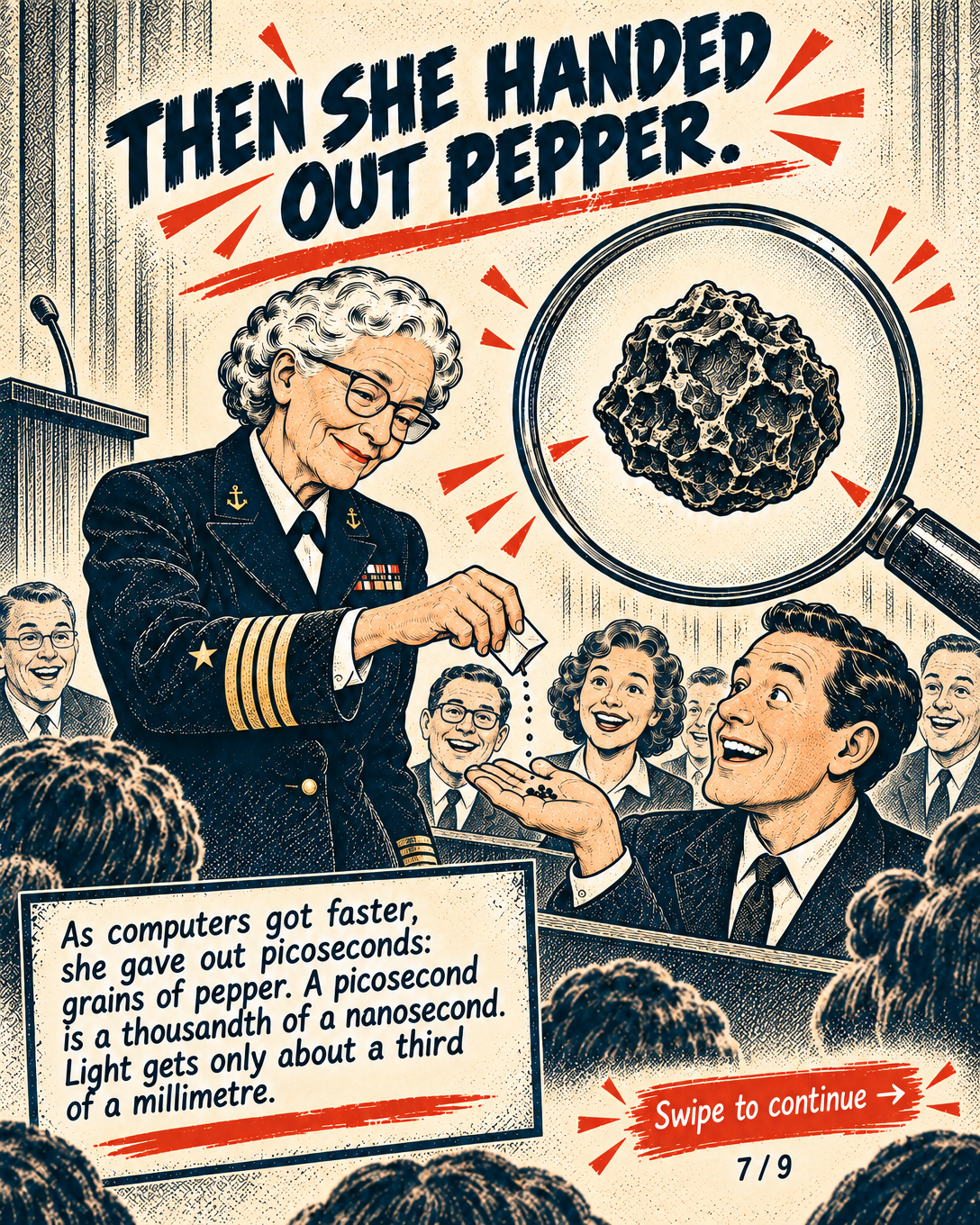
THEN SHE HANDED OUT PEPPER.
As computers got faster, she gave out picoseconds: grains of pepper. A picosecond is a thousandth of a nanosecond. Light gets only about a third of a millimetre.
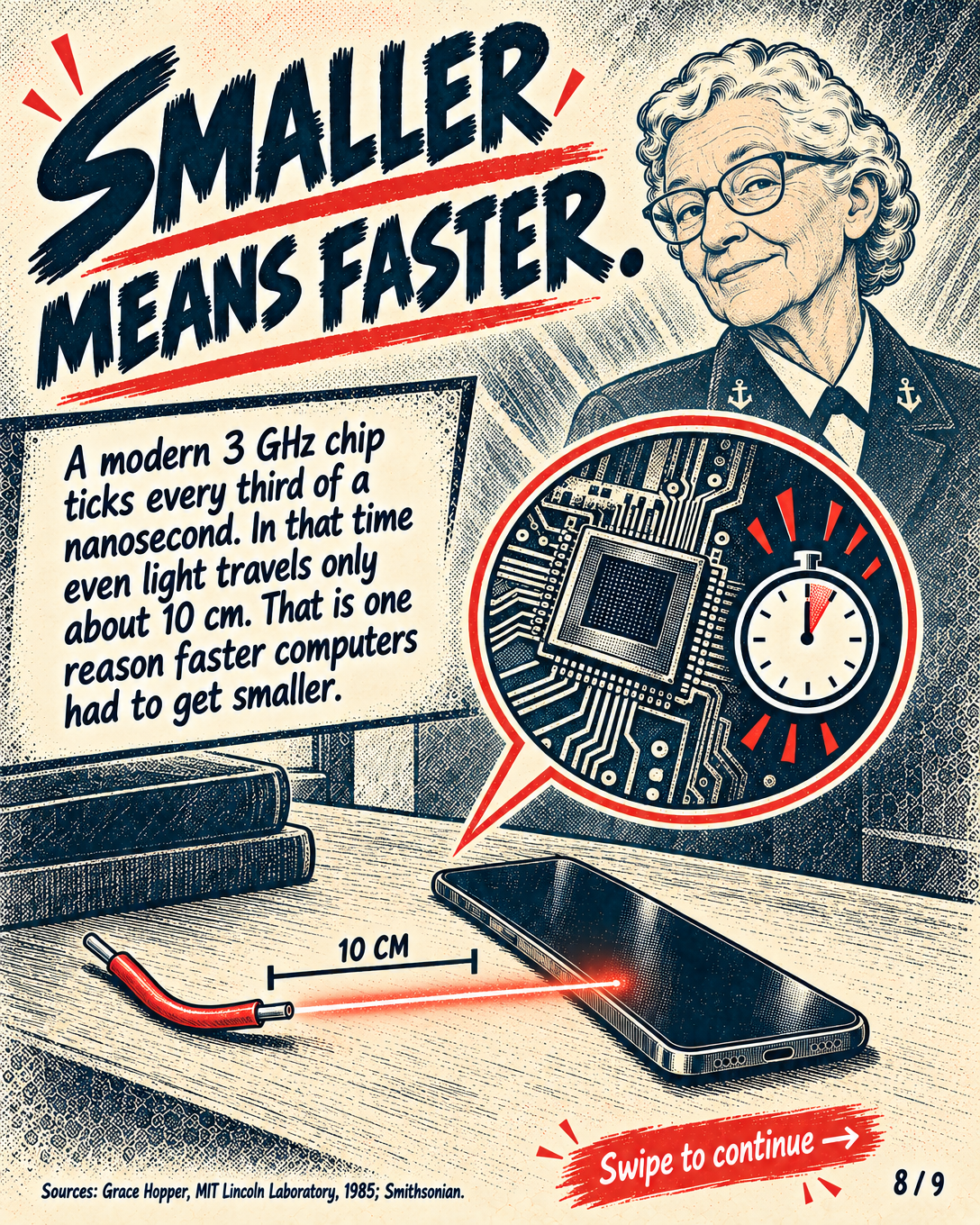
SMALLER MEANS FASTER.
A modern 3 GHz chip ticks every third of a nanosecond. In that time even light travels only about 10 cm. That is one reason faster computers had to get smaller.
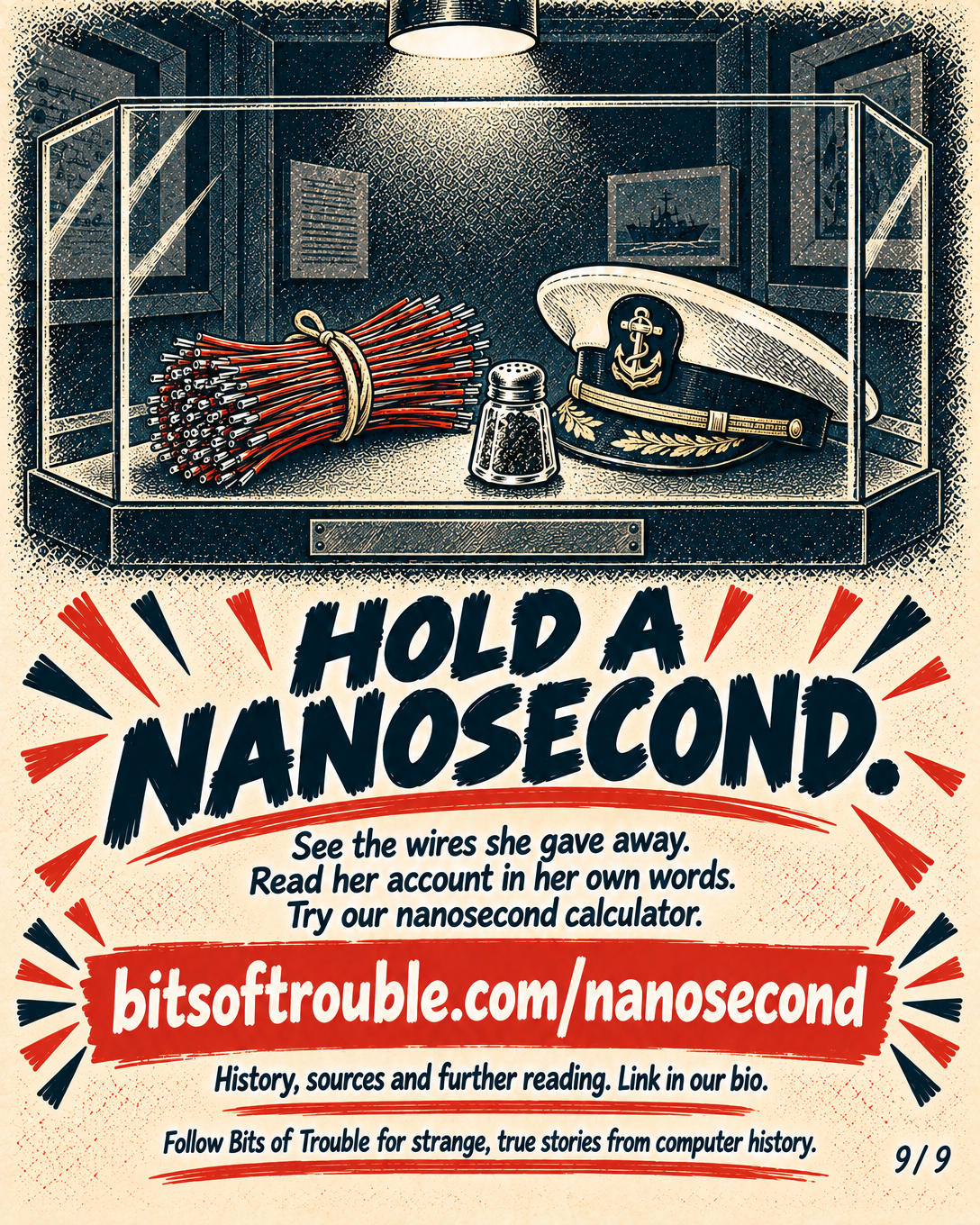
HOLD A NANOSECOND.
See the wires she gave away. Read her account in her own words. Try our nanosecond calculator.
Behind the pictures
A billionth of a second,
explained.
Who was Grace Hopper?
Grace Murray Hopper (1906–1992) was a mathematician who taught at Vassar before joining the US Naval Reserve in the Second World War. In 1944 she was assigned to Harvard, where she became one of the first people to program the Mark I, a 15-metre electromechanical calculator used for wartime calculations. She went on to shape how we write software, pushing for programming languages that used English words; her FLOW-MATIC language fed directly into COBOL. She served in the Navy, on and off, until 1986. Read the Navy’s biography or the Smithsonian’s account of her Mark I work.
How small is a nanosecond?
A nanosecond is one billionth of a second. Numbers like that slide straight past us, so try this: a nanosecond is to one second what one second is to about 31.7 years. By the 1960s, computers were carrying out operations in millionths and then billionths of a second, and the people paying for them, from admirals to managers, were asked to care about times nobody could picture.
Why a piece of wire?
Hopper’s insight was to turn time into distance. Nothing travels faster than light, which covers about 300,000 km every second, or about 30 cm (11.8 inches) in a nanosecond. So a 30 cm wire is the furthest any signal could possibly travel in that time. In real cables signals are slower, often about two-thirds of the speed of light, so the true distance is shorter still. The wire is a ceiling, not a measurement. In her 1985 lecture at MIT Lincoln Laboratory she described simply ringing the engineering building and asking them to “cut off a nanosecond” and send it over. Read her account in her own words.
The admiral and the satellite
Hopper told audiences that an admiral once asked her why it took so long to send a message by satellite. Her answer, as she told it, was that there were a very large number of nanoseconds between here and the satellite. A geostationary communications satellite sits about 35,786 km above the equator. Light takes about 0.12 seconds to get there, around 120 million nanoseconds, and the same again to come back. That quarter-second round trip is still noticeable on satellite phone calls and satellite internet today.
Don’t waste a microsecond
For contrast she also had a microsecond made: a thousand nanoseconds, a coil of wire about 300 metres (984 feet) long. She suggested hanging one over every programmer’s desk “so they know what they’re throwing away” when they write wasteful code. Her point holds: a program that repeats a slow step millions of times turns tiny delays into real ones.
Then pepper
As machines got faster, a nanosecond stopped being small enough. According to the Smithsonian, Hopper began using grains of pepper to stand for picoseconds, trillionths of a second. In a picosecond light covers only about a third of a millimetre. The museum holds a bundle of about a hundred of her wire nanoseconds, brought to a lecture there in March 1985 to hand out. See the Smithsonian’s object record.
Why it still matters
A modern processor running at 3 GHz ticks three billion times a second: one tick every third of a nanosecond. In that time even light travels only about 10 cm, and signals inside a chip are slower. If the parts of a computer are too far apart, a signal cannot get from one to another within a single tick. That is one of the reasons faster computers had to become smaller, and why the distance between servers matters for the fastest networks. Hopper’s wire still explains the device you are reading this on.
What we know, and what we drew
The wire nanoseconds, their 30 cm length, the 984-foot microsecond and the pepper picoseconds come from Hopper’s own lecture and the Smithsonian’s records. She began handing the wires out in the late 1960s. The admiral exchange is her own humorous retelling; we have not found an independent record of it. The comic’s scenes, the engineer, the admiral and the programmer are illustrated reconstructions, not portraits. Hopper’s likeness is based on a 1984 US Navy photograph. The images are AI-generated illustrations with editorial review.
Try it
How many nanoseconds away?
Follow the evidence
Sources & further reading
- Grace Hopper, lecture at MIT Lincoln Laboratory, 25 April 1985 (transcript, Speakola)
Asking engineering to 'cut off a nanosecond'; 11.8 inches; microsecond 984 feet; admiral and satellite; 'what they're throwing away'
- Smithsonian National Museum of American History: Nanoseconds associated with Grace Hopper (1985.3088.01)
About 100 wires, 30 cm each; handed out from the late 1960s; March 1985 NMAH lecture; pepper as picoseconds
- Naval History and Heritage Command: Rear Admiral Grace Hopper
Biography: Naval Reserve 1943, Mark I at Harvard, retired 1986
- Smithsonian NMAH: Grace Hopper, the Navy and computers
Mark I work under Howard Aiken; wartime calculations